By Huda Abdelnur
This year’s High-Level Political Forum (HLPF) carries particular significance for the global sustainable development agenda. It marks the final in-depth review of Sustainable Development Goal 7 (SDG7) — ensuring access to affordable, reliable, sustainable and modern energy for all — before the 2030 deadline for achieving the Sustainable Development Goals.
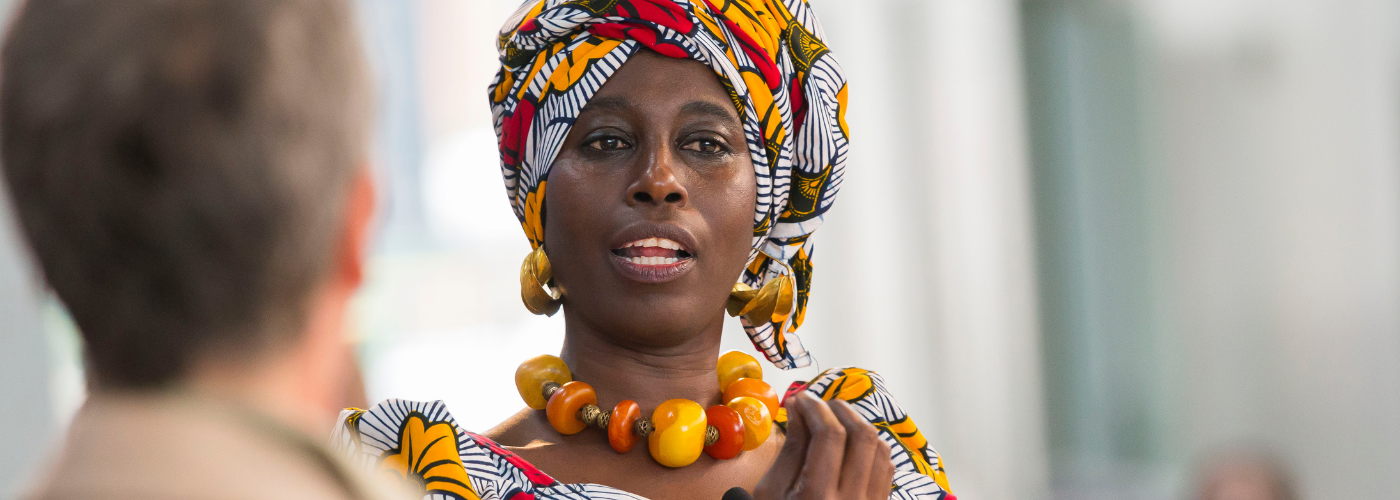
To discuss the outcomes of this year’s forum, the state of progress on SDG7, and the road ahead, we are joined by Sheila Oparaocha, Director of the ENERGIA International Network on Gender and Sustainable Energy, Co-Chair of the SDG7 Technical Advisory Group (TAG) and Co-Convenor of the Gender and Energy Compact. During the HLPF, Ms. Oparaocha has been actively engaged in the SDG7 review process and has contributed to several side events as a moderator, speaker and panelist.
Drawing on her extensive experience at the intersection of energy access, gender equality and sustainable development, Sheila shares her reflections on what has been achieved so far, where the gaps remain, and what will be needed to accelerate progress towards 2030 and beyond.
To improve readability, this interview has been divided into thematic sections. To view the questions and answers within each section, click the arrow to expand the content.
Reflections on the HLPF and SDG7 Review
This year’s HLPF may be the last formal review of SDG7 before the 2030 deadline. Looking back on the forum, did it meet your expectations? Why or why not?
“It has met my expectations. When I came here, I was expecting Member States to talk beyond the SDG indicators by discussing different dimensions such as inclusion and affordability. Because you can have access, which is really important, but how do people get involved? In the context of SDG7, people get involved when they can afford and use energy. It is also important to understand who is not using energy or not able to use it. And I’ve heard those conversations during my time here; there has been a lot of discussion about leaving no one behind, and even identifying vulnerable groups: women, youth, persons with disability and displaced persons, so that has been encouraging. So far, the draft of the Ministerial Declaration that we have received has exceeded our expectations. We came here expecting that there’s only going to be one line, and in fact it looked like one of the longest chapters and sentences in the Declaration highlighting what needs to be done, what the actions are, and what the solutions are. The draft also talked about women’s leadership, women’s agency, ultimately reflecting women’s aspirations. It also included notes on how to institutionalize it in the policies and budgets. Of course, we’ll wait to see if the draft of the paragraph will remain in the final output.”
What were the most important messages or outcomes that emerged from the SDG7 review discussions?
“This year in the review of SDG7 there has been space for women, particularly through the Women’s Major Group, to make an intervention. During the review there were 11 stakeholders including eight member states who talked about women’s leadership and agency and overall concern for women. Member States that strongly advocated for a gender transformative agenda for women were the Netherlands, UK, Ireland, Germany, Norway, Senegal, Sudan, and Lesotho. So, we are seeing countries coming from difficult situations and even conflict areas saying women’s rights matter and they matter even more. Furthermore, it is the nexus, the intersectionality between security, energy, and gender issues that we should be looking at. It was definitely apparent through these discussions that gender equality is an issue that should be placed at the forefront of SDG7.”
Were there issues, perspectives or stakeholders that you felt were missing from the conversations? What could have been done differently to make the review more impactful?
“This may be a bit controversial, but I think there needs to be much more engagement around the Ministerial Declaration. Yes, it’s a member state document, but I think member states can reach out to others to support them in the thinking, to really get a sense of where the global community thinks things should go. So, I think having a much more open process, where you have much more engagement, and of course, at the end of the day, it is our Member States who have to decide, but let’s have a consultative process that leads to that. The report comes out; it goes directly to member states; they start negotiating it, and it’s hardly seen by the rest of the world. So, this is going to be a key outcome document, and we want it to be negotiated because if it’s negotiated, it then carries the weight of our member states agreeing to it collectively.
Another thing that I think is that there could be more time for major groups to contribute to discussions. Indigenous people, youth, and women could be given much more time to engage, given that they only get one chance during the review. Another dimension that could have been explored more was intersectionality – how things intersect for different people. You can be a Black women living in poverty in a rural area compared to an urban area.”
Assessing Progress on SDG7
As Co-Chair of the SDG7 Technical Advisory Group, how would you assess global progress on SDG7 since its adoption in 2015?
The SDG 7 Technical Advisory Group has worked extensively to be well prepared for the HLPF. Part of the work that had to be undertaken was looking at the intersectionality of energy with all of the SDGs.
The Technical Advisory Group successfully launched the SDG 7 Policy Brief developed in support of the HLPF, and, most importantly the Key Messages for Policymakers, which go directly to the ECOSOC presidency, who is chairing the HLPF. The launching event was very well attended by Member States and other stakeholders, who talked about issues concerning SDG7. We could see that some of the reflections, advice, and guidance that were given were reflected in the panel discussion and in the Member States’ comments.
I would also like to highlight UN-Energy. I have been involved with UN-Energy since 2015 and have witnessed consistently growing concerted efforts within the group to develop a work program and identify key action points to ensure progress is being made. These efforts resonate well with what I believe is the UN-Energy’s mandate.
Another thing that stood out was how important clean cooking was. Every Member State I heard during the review brought up clean cooking, and these were Member States from all levels of development. So, there is political momentum and the will to change this problem, and the fact that it is being recognized at this level is promising. This now needs to be followed by acceleration and advancement of technology and institutional instruments to achieve the clean cooking indicator within SDG 7.”
Where have we seen the most significant advances, and what factors have driven that progress?
“Firstly, there has been great recognition that one of the things holding back SDG 7 is not having indicators on gender. I think that’s now a narrative that has been accepted. We saw this among the Member States at the side event [From Call to Count: Gender-Responsive Energy Actions for the Final Mile, red.] The Member States did not deny it—they agreed; they aligned with it, and nobody is saying that this is not an issue. Everyone is saying, “Yes, it’s an important issue, and we have to drive that.”
What I was really, really pleased about was that the background work had been done and the Country Mapping had been completed. The goal of the Country Mapping project is to identify and document what type of disaggregated gender-energy data or lack thereof already exists. We have completed 20 countries, and we are aiming to add an additional 30 for the analysis. Having the Country Mapping means you can already start seeing the trends, and the message is actually that the data is there. So, it’s not that there’s no data, or that we can’t do anything. It’s just a question of doing the right analysis, doing the right disaggregation, and putting the information in the right reporting channels.”
Challenges and Barriers to achieving SDG7
What are the main barriers preventing faster progress on universal access to sustainable and affordable energy?
“Maybe what I wanted a little more, was to really talk about — and this is a significant barrier to acceleration of SDG7 — is financing and investment. Something that was emphasized throughout the HLPF particularly by Member States, especially developing countries and least developed countries, was the need for greater public and private partnerships, financing, investment, and capacity building.”
Looking Ahead to 2030 and Beyond
What role do you see for civil society, local communities and the private sector in helping to close the remaining energy access and sustainability gaps?
“I think there’s no point in history where the UN is more relevant. It brings all of these entities together around the issues that are absolutely relevant and pertinent. That brings a beacon of hope, and you need to have a platform that enables this kind of collaboration. That’s where civil societies, local communities, governments, and the private sector can all come together to shape solutions.
The collaborations we had with UN Women were very important, as they were heavily involved in carrying this agenda, given that they are the custodian of SDG 5 and we are talking about the interlinkages between SDG 5 and SDG 7. Additionally, the collaboration with the World Bank has been excellent. For me, this process has been an example of the types of partnerships that are practical and that work and make a difference.
This was also a common theme throughout the discussions: the importance of public-private partnerships, multilateralism, and inclusive, engaging processes to accelerate progress within SDG 7.”
Looking beyond 2030, what lessons from the SDG7 journey should shape the next generation of global energy and development goals?
“We can’t talk about post-2030 now because Member States have agreed that they are going to do it in 2027. My only concern is that it might be too late. I think we are currently in a much more politically difficult space with energy, and we have to start preparing. Most importantly, we need to have time to reflect and see what people on the ground are saying. The post-2030 Agenda needs to come from the countries; it needs to start with the communities. It takes time to translate the concerns and experiences emerging from communities into proposals that can be advanced at the global level—proposals that are meaningful, evidence-based, and aligned with human rights and development priorities. While UN processes can be slow, the issues at stake affect real people who want to see change. Their voices must be heard and reflected in our work. My concern is that three and a half years from now, we may still be at the beginning of that journey. We need to start laying the groundwork now, so that when we engage with Member States, we can do so with confidence, backed by broad global support and a clear set of recommendations.”
Finally, are you optimistic that the world can still deliver on the promise of sustainable energy for all? What gives you hope, and what concerns you most?
“I am optimistic. My glass is more than half full, it’s 3/4 full. Despite the geopolitical climate, the HLPF brought Member States, stakeholders, and civil societies together to engage in pertinent conversations and deliberate on critical next steps. I was afraid people would come here in a combative mode, which was far from what occurred.
I think another thing that makes me very optimistic is the Women’s Major Group (WMG). I’m so pleased I have been engaged with the WMG since the Commission on Sustainable Development, during its earlier stages. It’s a space where gender-diverse groups can also come and be comfortable to organize and discuss with honesty.
Throughout the HLPF, we even had people coming in online and engaging. Everybody’s voice counts. Everyone is quite driven and knows what we want to do. Immediately, on day one, we start planning what we are sharing and learning. You have young people coming in, you have veterans of the process, and it’s a very supportive environment.
I always get so much energy and so much pride from coming into a place and seeing that this is how women work together—with respect, with compassion, caring about each other, but also being very strategic, very driven, very passionate, and really wanting to create change. Despite having different agendas, we are all able to come together with a common objective. And right now, we’re really talking about systems change. So, I just hope this type of leadership that we have, is something that we can see much more of in our political sphere.”