Insight Series: Advancing Gender & Social Inclusion in Clean Cooking Markets
Discover evidence, insights, and practical strategies that are reshaping clean energy access—by putting women and marginalized communities at the center.
Across the world, 2.1 billion people still rely on polluting cooking solutions, disproportionately affecting women and children. Real change happens when clean cooking isn’t just a technology shift—but a social transformation driven by gender equality, social inclusion and market innovation.
Over the past five years, ENERGIA has worked closely with implementing partners of the Strengthening the Entrepreneurial Ecosystem for Clean Cooking (SEE-Clean Cooking) programme to integrate gender considerations into their projects. Throughout this process, we have captured key lessons, insights, and recommendations in a series of publications. We hope these resources will support the adoption of similar gender-responsive approaches across other clean cooking initiatives.
Explore Our Publications
Lessons and Good Practices from Clean Cooking Programs
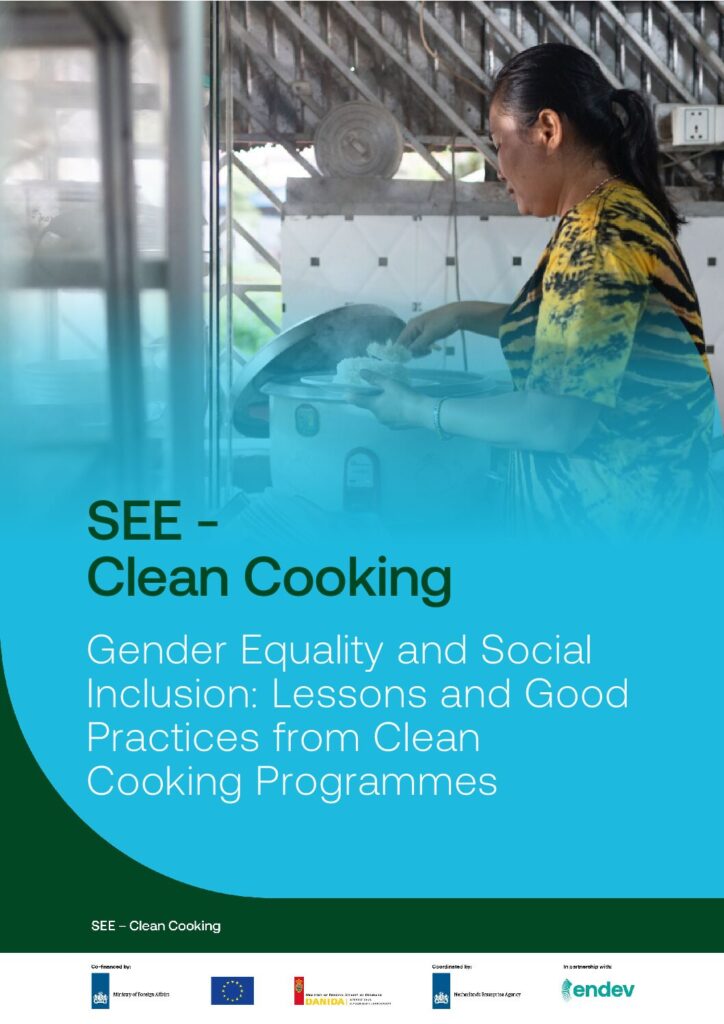
The report synthesises lessons and good practices for integrating gender equality and social inclusion (GESI) into clean cooking programmes. It shows that women and marginalised groups are central to market growth as users, entrepreneurs, and influencers, yet face barriers such as limited access to finance, information, and decision-making roles. The report emphasises that effective programmes start with gender analysis and implement targeted interventions across both demand and supply sides, including capacity building, inclusive financing, and supportive policies to create more equitable and sustainable clean cooking markets.
Building Inclusive Clean Cooking Markets
This report presents a practical framework for mainstreaming gender equality and social inclusion (GESI) in clean cooking market systems, drawing on lessons from the SEE Clean Cooking programme across Africa and Asia. It demonstrates how addressing barriers faced by women and other socially excluded groups can strengthen enterprise development, improve access to finance and clean cooking solutions, and enhance market performance. The report provides actionable guidance for practitioners seeking to embed GESI across programme design, implementation, monitoring, and policy engagement to build more inclusive and sustainable clean cooking markets.
Building Inclusive Clean Cooking Markets – EXECUTIVE SUMMARY
Thematic briefs
Gender-responsive electric cooking: Insights from programmes in Nepal and Cambodia
This brief explores how integrating gender and social inclusion enhances electric cooking programmes in Nepal and Cambodia. It finds that e-cooking can significantly reduce women’s workload, health risks, and reliance on biomass, while positioning women as key adopters and promoters of clean cooking technologies. However, gender norms and unequal access to resources limit uptake. The brief recommends targeted awareness campaigns, hands-on training, improved affordability, reliable electricity access, and support for women entrepreneurs to ensure more inclusive, effective, and sustainable electric cooking markets
Why a gendered approach to supporting the use and trading of bioslurry and bioslurry enriched compost is needed in Africa
This brief highlights the importance of applying a gendered approach to bioslurry market development in Sub-Saharan Africa. It shows that women, despite playing central roles in agriculture and household energy, face barriers to accessing inputs like fertilisers. Bioslurry offers a locally produced, affordable alternative that can improve soil health, increase productivity, and create income opportunities. The brief argues that gender-responsive policies, financing, training, and awareness are essential to enable women’s participation and maximise the economic, environmental, and social benefits of bioslurry markets.
Gender and Social Inclusion in the Sahel: Implications for Biodigester Market Development
This thematic brief examines how gender and social inclusion shape biodigester market development in the Sahel. It highlights women’s central roles as users, decision-makers, and entrepreneurs in biodigester and bioslurry value chains, while noting persistent social, financial, and cultural barriers limiting their participation. The report shows that gender-responsive approaches improve adoption, agricultural productivity, and income generation. Drawing on case studies from Burkina Faso, it provides practical recommendations for clean cooking programmes and practitioners to foster inclusive, sustainable clean energy markets.
The Strengthening the Entrepreneurial Ecosystem for Clean Cooking (SEE-Clean Cooking) programme is funded by the Danish and Dutch Ministries of Foreign Affairs and the European Union. It is coordinated by the Netherlands Enterprise Agency (RVO), in partnership with Energising Development (EnDev).
The programme promotes clean cooking solutions such as biodigesters and higher-tier cookstoves, including electric cooking technologies and advanced biomass stoves. It supports key market actors—such as local small and medium-sized enterprises (SMEs), government institutions, and financial organisations—to strengthen the overall ecosystem.
The programme consists of two main components: The African Biodigester Component (ABC) and The Higher-Tier Cooking Component (HTCC), and is implemented across eight countries: Bangladesh, Burkina Faso, Cambodia, Ethiopia, Kenya, Mali, Niger, and Uganda.